
 EN
A 35 kV distribution transformer sits at the boundary between a medium-voltage supply and the equipment that consumes the power. Utilities, industrial parks, commercial districts and renewable collection systems all use the 35 kV level for distribution or sub-transmission, and the transformer that interfaces that level has to be matched to the load, the upstream protection and the secondary utilisation voltage. Capacity, the high-voltage and low-voltage windows, tapping range, losses, impedance and vector group all have to line up. When they do, the unit runs quietly for decades; when they do not, the result is overheating, nuisance protection trips, or a secondary voltage that fails to meet expectations.
Yawei builds a 35 kV distribution transformer range covering both liquid-filled and dry-type designs. This article works through the ratings and vector groups that Yawei publishes, explains how to read a vector group such as Yd11 or Dyn11, and shows how to line up nameplate data with the real duty of a project.
Capacity ratings: what the numbers mean
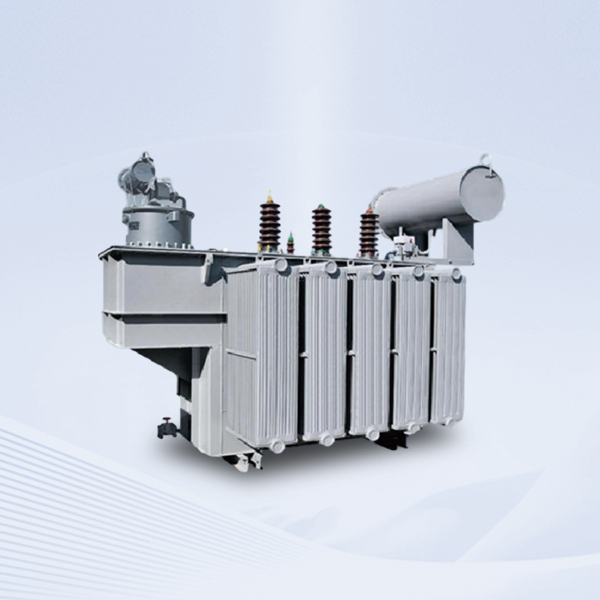
In North American practice, distribution transformers are often described in kVA; in IEC practice, larger units are described in MVA. A 35 kV distribution transformer spans a wide envelope, because the same voltage class is used both for a small industrial feeder transformer and for a large distribution substation unit. Yawei's oil-immersed 35 kV three-phase, double-winding range is published from 630 kVA up to 31,500 kVA — that is 3.15 MVA to 31.5 MVA. The dry-type 35 kV range is published from 800 kVA up to 25,000 kVA.
That spread matters at the enquiry stage. A capacity that is too small for the calculated load, or that is taken from a nominal figure without checking the duty cycle, will run hot and age early. A 35 kV distribution transformer that is deliberately oversized, on the other hand, wastes capital and runs at a poor utilisation point, which raises no-load losses. The practical approach is to size from a load calculation that already includes diversity and future growth, then confirm the standard catalogue rating that covers it.
The high-voltage and low-voltage windows
The high-voltage (primary) window for Yawei's 35 kV units is 35 kV to 38.5 kV. The low-voltage (secondary) window is 3.15 kV to 10.5 kV for the oil-immersed range and 3.15 kV to 11 kV for the dry-type range. These secondary voltages are the practical point of a distribution transformer: they feed the next stage of the network or the plant's medium-voltage switchgear, rather than a final low-voltage utilisation level. Checking the secondary against the actual downstream system — and deciding early whether a neutral is required — prevents a redesign at the factory drawing stage.
Tapping range
The tapping range compensates for a supply voltage that is not exactly nominal. The oil-immersed 35 kV distribution transformer range is published with a tapping range of plus or minus 2 × 2.5 percent; the dry-type range is offered with plus or minus 2 × 2.5 percent or plus or minus 5 percent. Taps are selected on a no-load tap changer, and, where the supply varies during service, on an on-load tap changer. The tap range should be wide enough to cover the realistic spread of the incoming voltage, but not so wide that it invites misuse.
Vector groups explained
A vector group is shorthand for how the primary and secondary windings are connected, and how much phase displacement exists between them. For a 35 kV distribution transformer, the published vector groups are:
- Yd11 or YNd11 for the oil-immersed three-phase, double-winding range. "Y" means the primary is star (wye) connected, "d" means the secondary is delta connected, "N" indicates that the primary neutral is brought out, and "11" is the clock notation for a 30-degree phase displacement (the secondary leads by 30 degrees, equivalent to the 11 o'clock position).
- Dyn11, Yd11 or Yyn0 for the dry-type 35 kV range. "Dyn11" means a delta primary, a star secondary with neutral, at the 11 o'clock displacement; "Yyn0" is a star-star connection with neutral and no phase displacement.
Vector group selection is not cosmetic. It determines whether the transformer can be paralleled with an existing unit, whether a neutral is available for earthing or for a four-wire secondary, and how the transformer interacts with the zero-sequence path seen by protection relays. A frequent error is to order a Dyn11 dry-type unit for a network that already runs YNd11 equipment, then discover that the 30-degree phase displacement prevents the two from being paralleled without an intervening phase shift. The vector group should therefore be written into the specification at the same time as the capacity, not chosen from a catalogue default at the end.
Losses and short-circuit impedance
Two further numbers travel with every 35 kV distribution transformer. No-load loss is the energy consumed by the core when the unit is energised with no secondary load; on the oil-immersed range it is published from 1.7 kW to 11.1 kW. Load loss (copper loss) is the energy dissipated in the windings under load, published from 20.7 kW to 100.8 kW. The no-load current is published from 0.20 to 0.36 percent.
Short-circuit impedance is published at 7.0, 8.0 or 10.0 percent for the oil-immersed range. Impedance is the parameter that links voltage regulation to fault current: a higher impedance limits fault current but increases voltage drop, while a lower impedance improves regulation but allows larger fault currents into downstream equipment. It is chosen with the protection scheme and the network in mind, not in isolation.
Dry-type parameters, for comparison, include an impedance of 6.0 to 10.0 percent, a no-load current of 0.30 to 0.85 percent, no-load loss of 2.02 to 24.3 kW, and load loss across three temperature-rise classes (B, F and H, at 100, 120 and 145 degrees Celsius). These figures should be read against the intended cooling and ambient conditions rather than treated as interchangeable.
Oil-immersed or dry-type — which 35 kV distribution transformer?
Both designs cover the 35 kV class, but they suit different sites. Oil-immersed units are typically more economical at high capacity and are suited to outdoor substations, coastal or chemically aggressive environments and heavy industrial loads. Dry-type units avoid liquid handling, are preferred for indoor installation, and are well suited to buildings, tunnels and locations where fire risk and oil containment are concerns. Whichever type is chosen, the same discipline applies: fix the capacity from the load, fix the secondary voltage from the downstream system, choose the vector group for the network, and confirm the impedance and loss figures against the project's efficiency and protection requirements.
How the ratings work together
The parameters on a 35 kV distribution transformer are not independent. Capacity sets the current the windings carry, the voltage windows set the insulation and turns ratio, the tapping range absorbs supply variation, and the vector group fixes the phase relationship. Change one and the others move. A 35 kV distribution transformer specified for an industrial feeder at, say, 2,500 kVA with a Dyn11 secondary will behave very differently from the same capacity arranged Yd11, because the neutral availability and the harmonic path change.
It also helps to think in terms of the project stage. At concept stage, the engineer needs only the capacity band, the voltage ratio and the vector group. At tender stage, the comparisons that matter are impedance, losses, tapping range and cooling. At contract stage, the exact losses and impedance become acceptance figures, and the test regime is fixed. Reading a 35 kV distribution transformer data sheet in that order — capacity, voltage, vector group, tapping, impedance, losses, cooling — keeps the commercial conversation anchored on the parameters that actually determine performance, and stops a low headline price from hiding a high loss figure or an impedance value that will not coordinate with the protection.
From rating to a real project
Ratings on a data sheet only mean something when they survive a real installation of a 35 kV distribution transformer. Yawei's official case pages include a 115 kV substation project delivered for the American - Puerto Rico Power Distribution Company, built after hurricane damage to strengthen grid resilience. The scope covered design, engineering, manufacturing, testing, delivery, installation and trial operation, with a reinforced structural design for wind resistance, corrosion-resistant equipment selection, redundant backup systems, and integrated distributed-energy access points with a faster fault-isolation system. The official case page does not disclose the project date. That project is rated above the 35 kV class, so it is not presented here as a 35 kV order; it illustrates the delivery and resilience engineering that also underpins medium-voltage distribution equipment, and it shows the extra caution — corrosion, wind, redundancy — that a coastal or storm-exposed 35 kV distribution transformer installation also demands.
Specification checklist
Before issuing a purchase order for a 35 kV distribution transformer, confirm:
- Rated capacity in kVA or MVA, matched to the calculated and future load.
- Primary voltage window (35–38.5 kV) and the actual system voltage and its variation.
- Secondary voltage (3.15–10.5 kV oil-immersed; 3.15–11 kV dry-type) and whether a neutral is required.
- Vector group (Yd11/YNd11 for oil-immersed; Dyn11/Yd11/Yyn0 for dry-type) and its compatibility with any paralleled units.
- Tapping range and tap-changer type.
- Short-circuit impedance (7.0/8.0/10.0 percent on the oil-immersed range).
- No-load and load loss values against the project efficiency requirement.
- Cooling method and the site's ambient conditions.
FAQ
What capacities are typical for a 35 kV distribution transformer?
Yawei publishes the oil-immersed three-phase, double-winding range from 630 kVA to 31,500 kVA, and the dry-type range from 800 kVA to 25,000 kVA.
Which vector groups are used on a 35 kV distribution transformer?
The oil-immersed range uses Yd11 or YNd11; the dry-type range uses Dyn11, Yd11 or Yyn0.
What is the difference between Yd11 and Dyn11?
Yd11 has a star primary and a delta secondary at the 11 o'clock (30-degree) displacement; Dyn11 has a delta primary and a star secondary with neutral at the same displacement. The choice depends on the network earthing and on what the unit must parallel with.
Does the vector group affect protection settings?
Yes. The connection and phase displacement change the zero-sequence path and the phase relationship seen by protection relays, so the vector group should be agreed with the network operator before the order is placed.
Can a 35 kV distribution transformer be used outdoors?
Yes. Oil-immersed units are built for well-ventilated indoor and outdoor service, including coastal and chemically aggressive sites; the site conditions should be stated at enquiry so the tank finish and protection class match the environment.
For the final engineering review, treat 35 kV distribution transformer as a project-specific decision term rather than a substitute for the approved datasheet.
Quality Assurance & Standards Notes
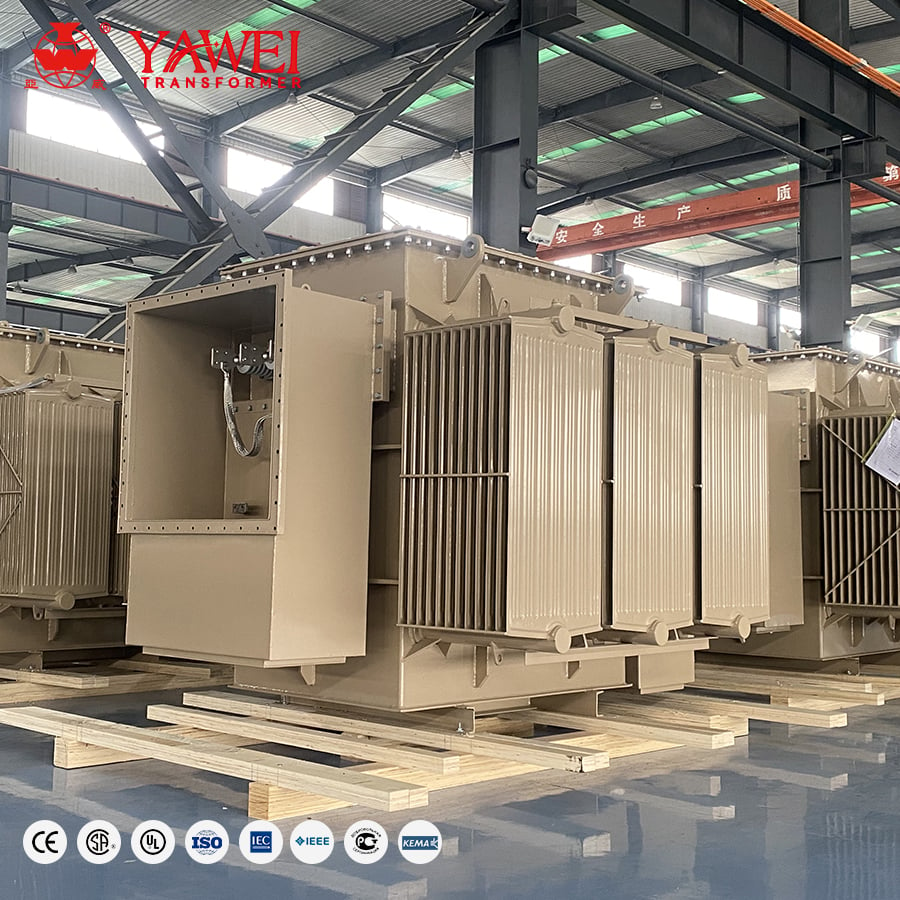
What convinces a reviewer is traceable evidence, not a badge. Yawei operates ISO 9001, ISO 14001, ISO 45001 and SA8000 management systems, and its 10 kV and 35 kV distribution transformers and box-type substations are described as holding IEC, UL, TUV, CE, KEMA and GOST certification. Product samples undergo routine, type and special tests at the National Transformer Quality Supervision and Inspection Centre, the Wuhan branch of the China Electric Power Research Institute, and the Suzhou Electrical Apparatus Research Institute. Because certification scope, certificate number, issuing body and validity must match the exact product and market, buyers should request the certificate for the specific 35 kV distribution transformer model and confirm its current validity before relying on it in a tender, rather than treating a general certification statement as proof of conformity. Parameters quoted above are published catalogue values for the listed ranges and should be confirmed against the issued data sheet for the selected model. For the published liquid-filled range, see the 35 kV oil-immersed transformer product page; for indoor or fire-sensitive sites, see the dry-type transformer range.
Table of Contents
- Capacity ratings: what the numbers mean
- The high-voltage and low-voltage windows
- Tapping range
- Vector groups explained
- Losses and short-circuit impedance
- Oil-immersed or dry-type — which 35 kV distribution transformer?
- How the ratings work together
- From rating to a real project
- Specification checklist
- FAQ
- Quality Assurance & Standards Notes