
 EN

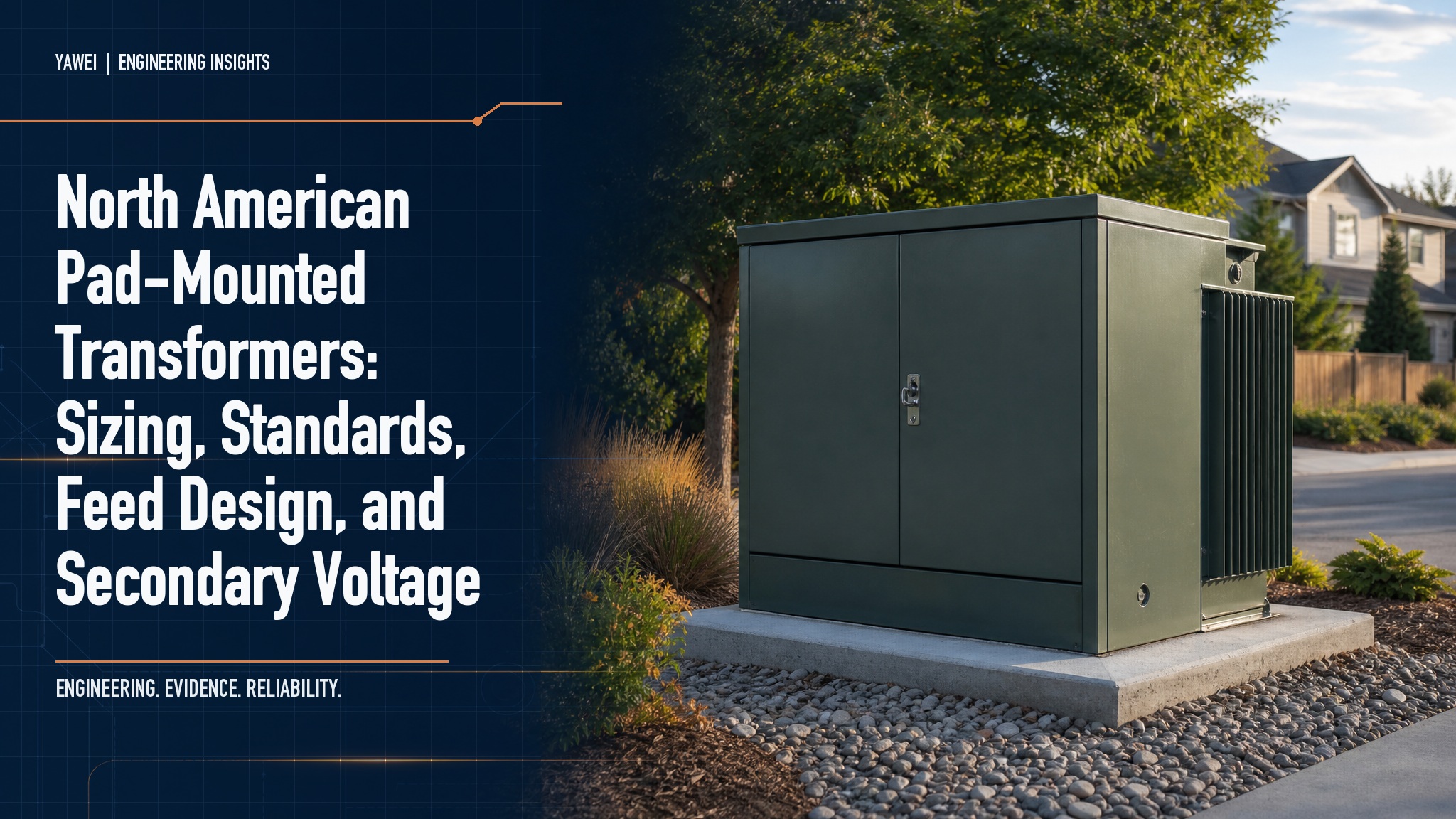
In North America, a large share of distribution is served by equipment that most customers never notice: a locked steel cabinet standing on a concrete pad, usually beside a sidewalk or at the edge of a parking lot, feeding homes and businesses through underground cables. That cabinet is a North American pad-mounted transformer, and the decisions behind it — single-phase or three-phase, how many units, which efficiency standard, loop-feed or radial, and what secondary voltage — are what determine whether a subdivision or commercial site is served reliably and economically.
This article walks through the four questions that a North American pad-mounted transformer specification must answer: how many units a project needs, which ANSI, IEEE and DOE standards apply, how the feed design is chosen, and what secondary voltage and connection the unit normally supplies.
Single-phase or three-phase, and how many units
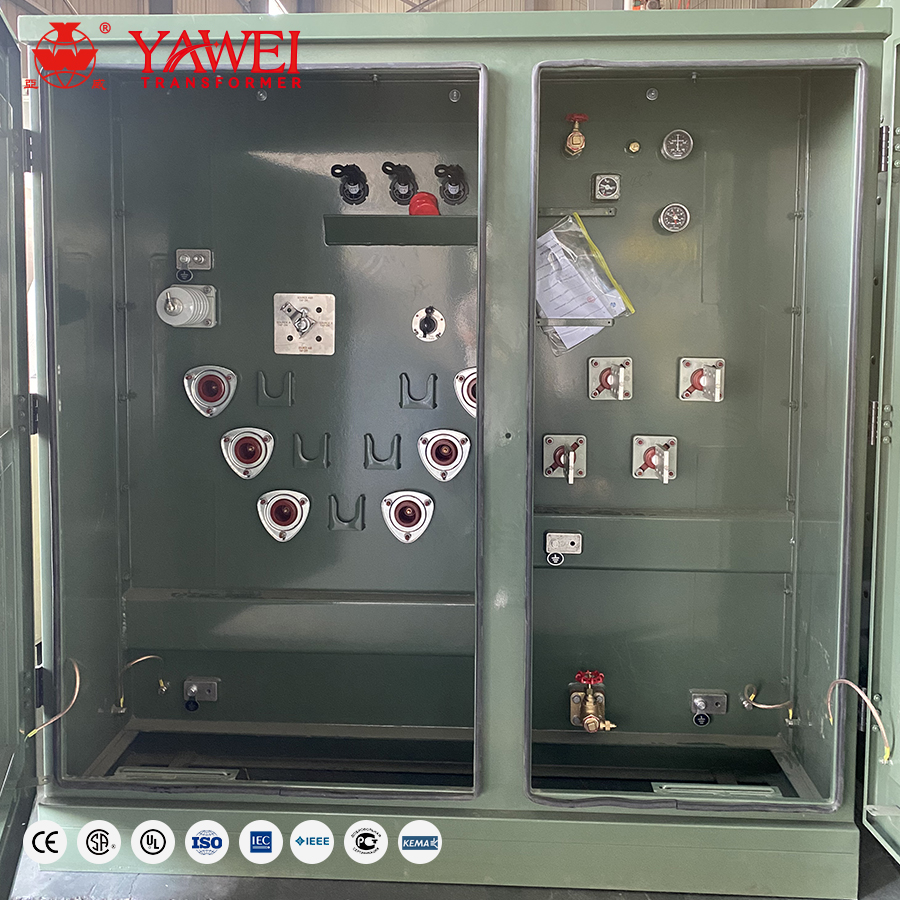
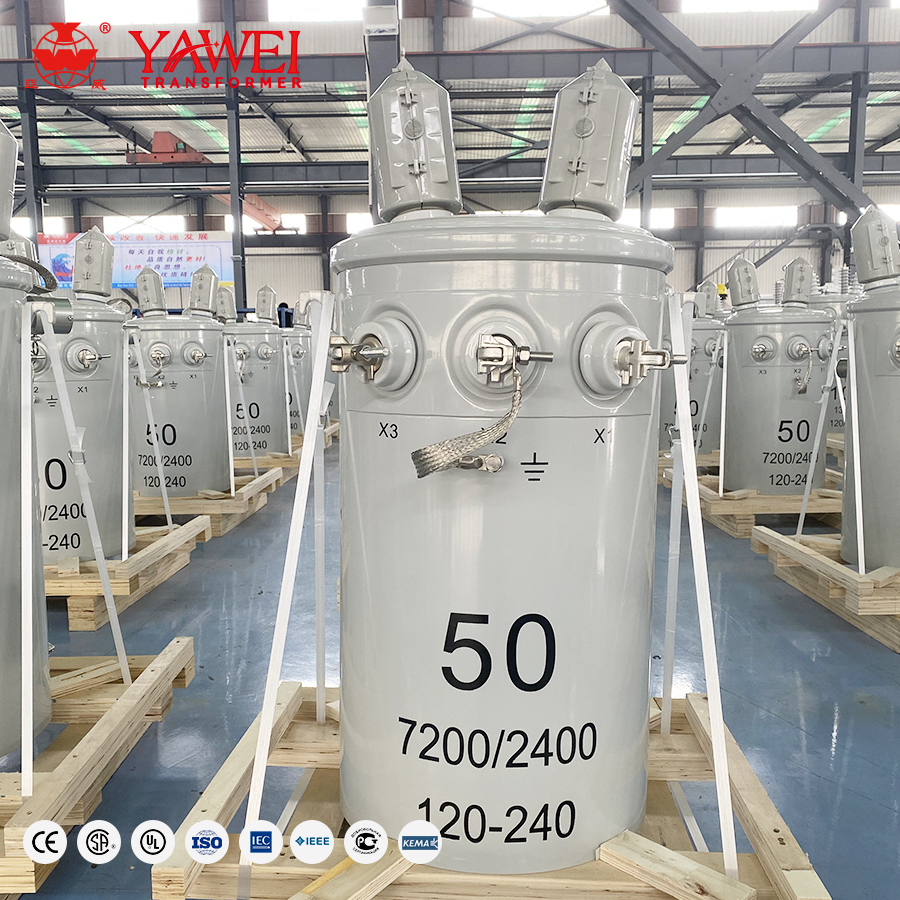
The first decision for a North American pad-mounted transformer is phase count. A single-phase pad-mounted transformer is used on underground distribution lines at service drops, stepping the primary voltage down to the lower secondary voltage supplied to utility customers, and a single unit may serve one large building or many homes. Yawei's single-phase pad-mounted range is published from 25 kVA to 500 kVA, with a primary voltage up to 34.5 kV and a secondary voltage of 120/240 V, built to CSA C227.3 and C802.1 energy-efficiency standards.
For a United States residential subdivision, the required North American pad-mounted transformer count is derived from the connected load and the diversity of that load, not from a fixed number. As a working rule, a typical single-phase unit that converts 7,200 V to 120/240 V feeds about 10 to 15 homes, or one or more small commercial businesses. A subdivision of 120 homes therefore needs on the order of eight to twelve units, sized and spread so that each transformer is close to the load it serves and the secondary service runs stay short. Longer secondary runs add voltage drop and cost, so the placement of each North American pad-mounted transformer is a load-layout exercise as much as an electrical one.
Three-phase service is used where the load is larger or where three-phase motors and equipment are present — commercial centres, light industrial parks and apartment buildings. Where a three-phase unit is chosen, the North American pad-mounted transformer is sized on the total three-phase load rather than on a per-phase estimate. Yawei's three-phase pad-mounted range is published with base ratings from 45 kVA up to 12,000 kVA, a primary voltage from 2,400 V to 46,000 V, a secondary voltage from 120 V to 24,940 V, and a basic impulse level (BIL) from 30 kV to 250 kV.
Standards and efficiency
Standards compliance is the second specification question, and in North America it is seldom optional. Three-phase pad-mounted units are built to meet the latest NEMA, ANSI and IEEE standards and to exceed Energy Star and DOE efficiency requirements. Yawei's published three-phase efficiency figures are DOE 2013 at 99.03 to 99.53 percent and CSA 2023 at 98.95 to 99.49 percent. Single-phase pad-mounted units are built to CSA C227.3 and C802.1 energy-efficiency standards, and the single-phase pole-mounted range publishes efficiency of DOE 2016 at 98.58 to 99.33 percent and CSA 2023.
The applicable reference documents for US and Canadian distribution work are the IEEE C57.12 series for transformers, the US National Electrical Code (NEC) for installation, and CSA standards for the Canadian market. Because a North American pad-mounted transformer is judged against the efficiency level in force in its jurisdiction and against the utility's own standard, the correct practice is to state the target market, the applicable efficiency level (for example DOE 2013 for the three-phase range above) and the installation code at the enquiry stage, rather than assume one standard fits both countries. Efficiency, impulse level and clearance requirements should be confirmed against the utility's specification before the order is placed.
Feed design: loop-feed versus radial
The third question is how the transformers are fed. Acceptance of loop-feed versus radial designs varies by region and by distribution architecture. Suburban and dense distribution networks tend to favour loop-feed, because a loop allows a faulted section to be isolated and the load to be supplied from the other direction, which raises supply reliability. End-of-line feeders, where there is nothing beyond the transformer, mostly use radial designs, which are simpler and cheaper to build.
The decisive factor is the utility. US and Canadian utilities each maintain their own technical standards and approval lists, and a North American pad-mounted transformer that is acceptable to one utility may not be on another's list. Buyers should therefore select the feeder arrangement according to the target utility's code and approval requirements, and confirm whether the connection is loop-feed or radial, and whether the unit must be dead-front and tamper-resistant, before specifying. This is one of the most common places where a technically sound proposal is rejected on submission.
Secondary voltage and connection
The fourth question is what the transformer delivers on the secondary side. Yawei's published data gives a single-phase pad-mounted secondary of 120/240 V, and a three-phase pad-mounted secondary from 120 V to 24,940 V, with the low-voltage table listing 240, 480Y, 480 V, 277 V, 600Y, 600 V and 347 V steps.
For a North American pad-mounted transformer, the connection arrangement follows the same logic. North American pad-mounted distribution commonly uses a delta-primary, wye-secondary connection — for example a delta/wye with a grounded-star secondary — because that arrangement provides both line-to-line and line-to-neutral voltages, which is what residential and light-commercial loads require. The specific secondary voltage and connection should be determined together with the local supply codes (IEEE C57.12 and the NEC) and the requirements of the load, not chosen by default. A North American pad-mounted transformer ordered with the wrong secondary voltage is an expensive mistake to reverse once it is set on its pad.
Installation clearances and site safety
A North American pad-mounted transformer is a live electrical asset sitting in public space, so clearances matter. Industry practice calls for combustible structures such as houses and garages to be at least 10 feet from a pad-mounted transformer, a distance that can be reduced to 3 feet for non-combustible structures. Working clearances around the unit are typically 8 feet to the left, 10 feet in front and 3 feet behind and to the right, rising to 5 feet on the right where metering is inside the enclosure. Keeping shrubs and trees at least 10 feet away, and never digging near the unit because of the buried cables, are part of the same safety picture. When a North American pad-mounted transformer is placed, the layout should reserve those clearances from the start, because they are difficult to recover later.
Secondary service and lifespan
The secondary service connects the North American pad-mounted transformer to the customer's service equipment. Residential single-phase units supply 120/240 V through an underground service, and the unit is expected to last around 30 years in normal service, with weather and salt shortening that figure. For commercial and light-industrial sites, a three-phase North American pad-mounted transformer supplies the higher secondary voltages listed above and often serves a building directly. Because the unit is sealed and pad-mounted, maintenance is limited to inspection, oil-condition checks where the design is liquid-filled, and periodic review of the connections and cooling components; planning for replacement at the end of service life is part of owning the asset.
A real project in the North American market
Entering the North American market is itself a test of standards compliance, and Yawei's official case pages include a 15 MVA pad-mounted transformer project delivered for an American Transmission Company. To meet the market, the product had to comply fully with US standards such as UL and IEEE, and Yawei developed and manufactured a 15 MVA American-style pad-mounted transformer using a fully sealed and fully insulated structure with SF6 or an environmentally friendly liquid as the insulating medium, described as maintenance-free, flood-proof and aesthetically suitable. From material procurement to production testing, the process followed US standards and obtained the relevant certifications. The official case page does not disclose the project date. That unit is rated at 15 MVA, above the typical North American pad-mounted distribution envelope, so it is not presented here as a standard residential unit; it does show how the sealing, enclosure and standards discipline that a North American pad-mounted transformer needs are applied at higher rating.
Sizing and specification checklist
Sizing a North American pad-mounted transformer is iterative, so the layout should be revisited as the electrical design firms up. Confirm:
- Single-phase or three-phase service, and the connected load with its diversity and future growth.
- Number and placement of units, keeping secondary runs short and voltage drop within limits.
- Base rating and primary voltage range (up to 34.5 kV single-phase; 2,400–46,000 V three-phase).
- Secondary voltage (120/240 V single-phase; 120–24,940 V three-phase, including the 240/277/480/600/347 steps).
- Efficiency level for the jurisdiction (for example DOE 2013 for the three-phase range).
- Applicable standards and codes (IEEE C57.12, the NEC, CSA) and the target utility's approval list.
- Feed arrangement (loop-feed or radial) and whether the unit must be dead-front and tamper-resistant.
- Clearance requirements around the pad, and the site's exposure and soil conditions.
FAQ
How many homes can one single-phase pad-mounted unit serve?
As a rule of thumb, a typical unit that converts 7,200 V to 120/240 V feeds about 10 to 15 homes, or one or more small commercial businesses; the actual number is set by the connected load and its diversity.
Which standards apply to a North American pad-mounted transformer?
The IEEE C57.12 series, the US NEC and CSA standards for Canada, together with the DOE efficiency level in force — for example DOE 2013 for the published three-phase range.
Is loop-feed or radial more common?
It varies by utility and network. Suburban and dense networks tend to use loop-feed for reliability; end-of-line feeders usually use radial. The target utility's standard decides.
What secondary voltage does the unit normally supply?
Single-phase units supply 120/240 V; three-phase units supply across the 120 V to 24,940 V span, including the 240/277/480/600/347 steps, usually through a delta-primary, wye-secondary connection.
For the final engineering review, treat North American pad-mounted transformer as a project-specific decision term rather than a substitute for the approved datasheet.
Quality Assurance & Standards Notes
For a North American pad-mounted transformer, the assurance evidence has to match the market as well as the product. Yawei operates ISO 9001, ISO 14001, ISO 45001 and SA8000 management systems, and its 10 kV and 35 kV distribution transformers and box-type substations are described as holding IEC, UL, TUV, CE, KEMA and GOST certification, with three-phase pad-mounted units described as meeting the latest NEMA, ANSI and IEEE standards and exceeding Energy Star and DOE efficiency requirements. Samples undergo routine, type and special tests at the National Transformer Quality Supervision and Inspection Centre, the Wuhan branch of the China Electric Power Research Institute, and the Suzhou Electrical Apparatus Research Institute. Because efficiency level, certificate scope, issuing body and validity must match the exact product and the specific utility and jurisdiction, buyers should obtain the certificate, the efficiency verification and the target utility's approval documentation for the specific North American pad-mounted transformer being purchased, and confirm they are current before award. Ratings, efficiencies and clearances quoted above are published catalogue values for the listed ranges and should be confirmed against the issued data sheet and the utility's specification. See the three-phase pad-mounted transformer product page and the single-phase pad-mounted transformer product page for the published ranges.
Table of Contents
- Single-phase or three-phase, and how many units
- Standards and efficiency
- Feed design: loop-feed versus radial
- Secondary voltage and connection
- Installation clearances and site safety
- Secondary service and lifespan
- A real project in the North American market
- Sizing and specification checklist
- FAQ
- Quality Assurance & Standards Notes