
 EN

Distribution utilities rarely approve a pole-mounted transformer on price alone. Before a unit enters an approved materials list, it must show that it clears a regulated minimum efficiency, that its losses are economically acceptable under the utility's own capitalized-loss model, and that it will survive the climate into which it is deployed. This article explains how a pole-mounted transformer efficiency review is structured: the ratings and impedance values that define the design envelope, the standards and loss-evaluation formulas used for qualification, and the environmental and planning factors that decide whether a specification is realistic in the field.
Ratings and impedance: the first filter
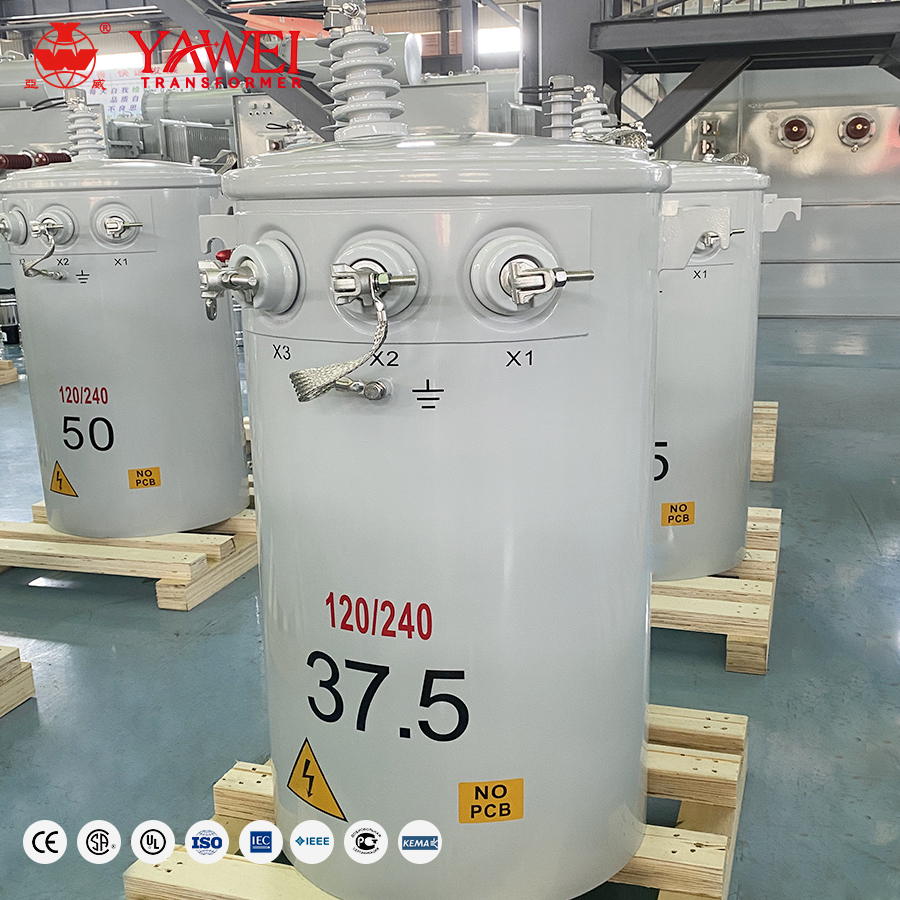
Every pole-mounted transformer efficiency assessment begins with the nameplate envelope. For single-phase pole-mounted distribution transformers, YAWEI publishes a rated-capacity range of 5–167 kVA, with primary voltages of 34.5/19.92 kV, 13.8/7.9 kV, 13.2/7.6 kV and 12.47/7.2 kV and secondary voltages of 120–240 V, 240–480 V, 347 V and 600 V. In rural networks the common capacity steps are 5, 10, 15, 25, 37.5, 50, 75, 100 and 167 kVA. Impedance is deliberately low, on the order of 1.5%–3%, so that voltage regulation stays inside the limits rural feeders can tolerate; the exact figure is fixed by ANSI/IEEE C57 and by each utility's published standards. A supplier that cannot state impedance at a given kVA is asking the utility to guess, and any pole-mounted transformer efficiency claim that is not tied to a defined impedance is not verifiable.
Conventional versus self-protected pole-mounted units
Utilities then decide between conventional and self-protected construction, and the choice changes how losses and protection are counted. Conventional pole-mounted transformers rely on external fusing and protection on the secondary side, so the utility's crews own more of the protection hardware and more of its maintenance. Self-protected types integrate internal high-voltage fusing and lightning protection into the unit, which simplifies installation, reduces footprint and lowers routine maintenance, and is therefore common in rural distribution. When the goal is to simplify on-site protection and cut installation and maintenance effort, the self-protected design may be preferred; where the network already has mature external protection, the conventional design remains acceptable. Because both variants can be offered at the same kVA and efficiency tier, the pole-mounted transformer efficiency of a bid should always be quoted together with the protection scheme it assumes.
Environmental and altitude conditions
Efficiency and life both depend on where the unit stands. YAWEI's single-phase pad-mounted platform is rated for altitudes up to 1,500 m, ambient temperatures from +40 °C to −20 °C and an annual average humidity not exceeding 90%, indoors or outdoors, and the same environmental logic governs pole-mounted selection in remote areas. Above roughly 1,000–1,500 m, insulation and heat dissipation must be corrected, with reference to IEC 60076-3. Extreme cold affects insulating oil and seals, while sustained heat reduces the margin available for heat dissipation; high humidity, salt spray and seismic activity each impose their own constraints. Under different geographic climates the buyer should therefore specify an appropriate anti-corrosion coating system and sealing, and raise the protection class where necessary. Any credible pole-mounted transformer efficiency figure assumes these corrections have already been applied to the base design.
The standards and loss-evaluation formulas behind pole-mounted transformer efficiency
This is where qualification becomes formal. Utilities commonly qualify pole-mounted transformers against ANSI/IEEE C57.12.20, the pole-mounted transformer standard, and screen candidates using the minimum efficiency required by energy-efficiency regulation — in North America, US DOE 2016 for single-phase pole-mounted units and Canadian CSA 2023. YAWEI publishes the following official efficiency steps for its single-phase pole-mounted line:
The published range is DOE 2016 98.58%–99.33% and CSA 2023 98.47%–99.28%. Above that floor, the commercial decision is usually made by loss evaluation rather than by efficiency alone. In practice the screen is a two-stage process. First, the utility removes any model that cannot meet its mandated minimum efficiency at the relevant capacity. Second, the remaining candidates are compared on the present value of their losses, not on the efficiency number itself — which is why a pole-mounted transformer efficiency figure is only the entry ticket, and the evaluated cost of losses is what actually decides the award. It is also worth stating the scope plainly: the DOE 2016 and CSA 2023 values above are market-specific minima for pole-mounted distribution transformers sold into the United States and Canada respectively, and they do not describe dry-type, power-class or non-North-American products.
From efficiency floor to evaluated cost
Capitalized loss evaluation is where pole-mounted transformer efficiency becomes money. The method isolates the two loss streams that a transformer produces for its whole life. No-load loss, also called iron loss, is essentially constant whenever the unit is energized, regardless of how much load it carries. Load loss, also called copper loss, varies approximately with the square of the load factor. A utility assigning a present-value cost to each stream uses its own electricity price and its own annual equivalent utilization hours, then sums the discounted cost of both streams over the assumed evaluation period. Because those coefficients are utility-specific, a manufacturer cannot legitimately claim a single universal "lowest loss cost". What a supplier can do is publish measured no-load and load losses at each capacity, quote them against a stated test standard and tolerance, and let the utility apply its own model. Under light loading — the normal condition for much of a rural pole-mounted fleet — no-load loss dominates pole-mounted transformer efficiency over the asset's life, so the iron-loss characteristic deserves more weight than the full-load headline figure.
Materials and coatings for coastal and high-humidity sites
Coastal and high-humidity service is a specification, not a detail. YAWEI states that its pad-mounted transformer tanks use C3–C5 anti-corrosion coating, that dry-type units in humid areas need suitable sealing, coatings and ventilation, and that humid or salt-spray sites — for example Canada's coastal provinces — require higher IP protection, special coatings and sealing technology to extend service life. Each of these measures protects the pole-mounted transformer efficiency that was qualified at the factory, because corrosion, moisture ingress and blocked ventilation all raise losses and shorten life in service.
Planning capacity for growing residential load and EV charging
Efficiency economics change the moment load grows. To plan pole-mounted transformer capacity for residential growth and electric-vehicle charging, the prudent approach is to reserve margin based on load forecasting — including the time-of-day characteristics and the coincidence factor of EV charging — to raise the capacity step or adopt an extensible, replaceable design where necessary, and to consider a three-phase upgrade or additional transformers to balance load. The intermittent, high-power nature of EV charging requires an explicit assessment of peak load and harmonic impact; capacity should be calculated from typical load curves and peak coincidence, with upgrade space reserved. Because a lightly loaded unit spends most of its life at low load factor, the pole-mounted transformer efficiency that matters most may be the no-load characteristic, not the full-load figure.
Writing pole-mounted transformer efficiency into the RFQ
A specification that survives evaluation states the numbers the utility will measure. Write pole-mounted transformer efficiency into the RFQ as a measured value rather than a marketing claim. At a minimum, the buyer should require: (1) the guaranteed no-load loss and load loss in watts at each offered capacity; (2) the test standard and the loss tolerance that applies, such as IEC 60076-1 where an IEC basis is used; (3) a minimum pole-mounted transformer efficiency at the rated capacity, aligned to the target-market regulation rather than to a generic figure; (4) the impedance value and the protection scheme assumed; and (5) a commitment to compare pole-mounted transformer efficiency against the utility's own loss coefficients during bid evaluation, so that two quotes on different efficiency tiers can be ranked on equal terms. Tenders that leave the loss tolerance and the capacity basis unstated routinely produce bids that cannot be compared.
Documentation utilities review during evaluation
Evaluation is ultimately a paperwork exercise, and the paperwork should be complete before a bid is opened. A typical utility review package asks for the technical data sheet at each offered capacity, the impedance value, the loss figures in watts, the applicable standard system, and the type-test report that shows how those losses were measured. Reviewers also look for evidence that the test was carried out at a recognized laboratory, that the report number and standard version are stated, and that the covered capacity and voltage class actually include the unit being quoted. Where an apparatus has been standardised across a fleet, the utility may ask for the routine-test record for each delivered unit and for the calibration status of the instruments used. In a competitive tender these documents let reviewers separate a genuine loss guarantee from a rounded catalogue figure, and they make it possible to apply the same loss-evaluation model to every bidder on the list.
Application example
An official example from YAWEI's single-phase pole-mounted range illustrates the design intent. The transformer uses a high-efficiency, energy-saving coil-and-core structure and a small footprint; the company states that it reduces the length of low-voltage distribution lines and achieves a low-voltage line loss reduction of over 60%. The published applications are rural power grids, remote mountainous areas, scattered villages, agricultural production and lighting, together with energy-saving renovation of railway and urban grids. YAWEI also lists export destinations for its pole-mounted and related range including the United States, Canada, Panama, Venezuela, Uzbekistan, Australia and Bulgaria. The official sources do not disclose a project date for this application, so no date is claimed here; what is verifiable is the stated application scope, the platform's published pole-mounted transformer efficiency goal, and the efficiency table above.
For the final engineering review, treat pole-mounted transformer efficiency as a project-specific decision term rather than a substitute for the approved datasheet.
Quality Assurance & Standards Notes
Utilities should treat the stated efficiency as a documented claim rather than a catalogue phrase, and the notes below summarize how it is evidenced.
- System and product qualifications: YAWEI states ISO 9001, ISO 14001, ISO 45001 and SA8000 system certification plus a Jiangsu enterprise metrology qualification, and states that its 10 kV/35 kV distribution transformers and substations hold IEC, UL, TUV, CE, KEMA and GOST certification.
- Test evidence: products are stated to pass routine, type and special tests at the National Transformer Quality Supervision and Inspection Center, the China Electric Power Research Institute (Wuhan) and the Suzhou Electrical Apparatus Research Institute. Buyers should request the type-test report with measured no-load and load losses, the applicable test standard and the IEC 60076-1 loss tolerance for the specific capacity and voltage; the IEEE C57.12.90 test code applies where an IEEE basis is specified.
- Market scope of efficiency references: ANSI/IEEE C57.12.20 applies to pole-mounted distribution transformers; the DOE 2016 and CSA 2023 values cited above are published efficiency steps for YAWEI's single-phase pole-mounted line intended for those markets, and should be confirmed against the exact target-market regulation before they are written into a specification.
- Verification: on-site witnessing of routine tests, or original test records and calibration certificates, should be requested so that pole-mounted transformer efficiency is confirmed for the actual unit delivered, not just for the type.
Internal references: Request the single-phase pole-mounted transformer data sheet, and review the pole-mounted transformer range, before finalizing a loss-evaluation model.
Table of Contents
- Ratings and impedance: the first filter
- Conventional versus self-protected pole-mounted units
- Environmental and altitude conditions
- The standards and loss-evaluation formulas behind pole-mounted transformer efficiency
- From efficiency floor to evaluated cost
- Materials and coatings for coastal and high-humidity sites
- Planning capacity for growing residential load and EV charging
- Writing pole-mounted transformer efficiency into the RFQ
- Documentation utilities review during evaluation
- Application example
- Quality Assurance & Standards Notes