
 EN
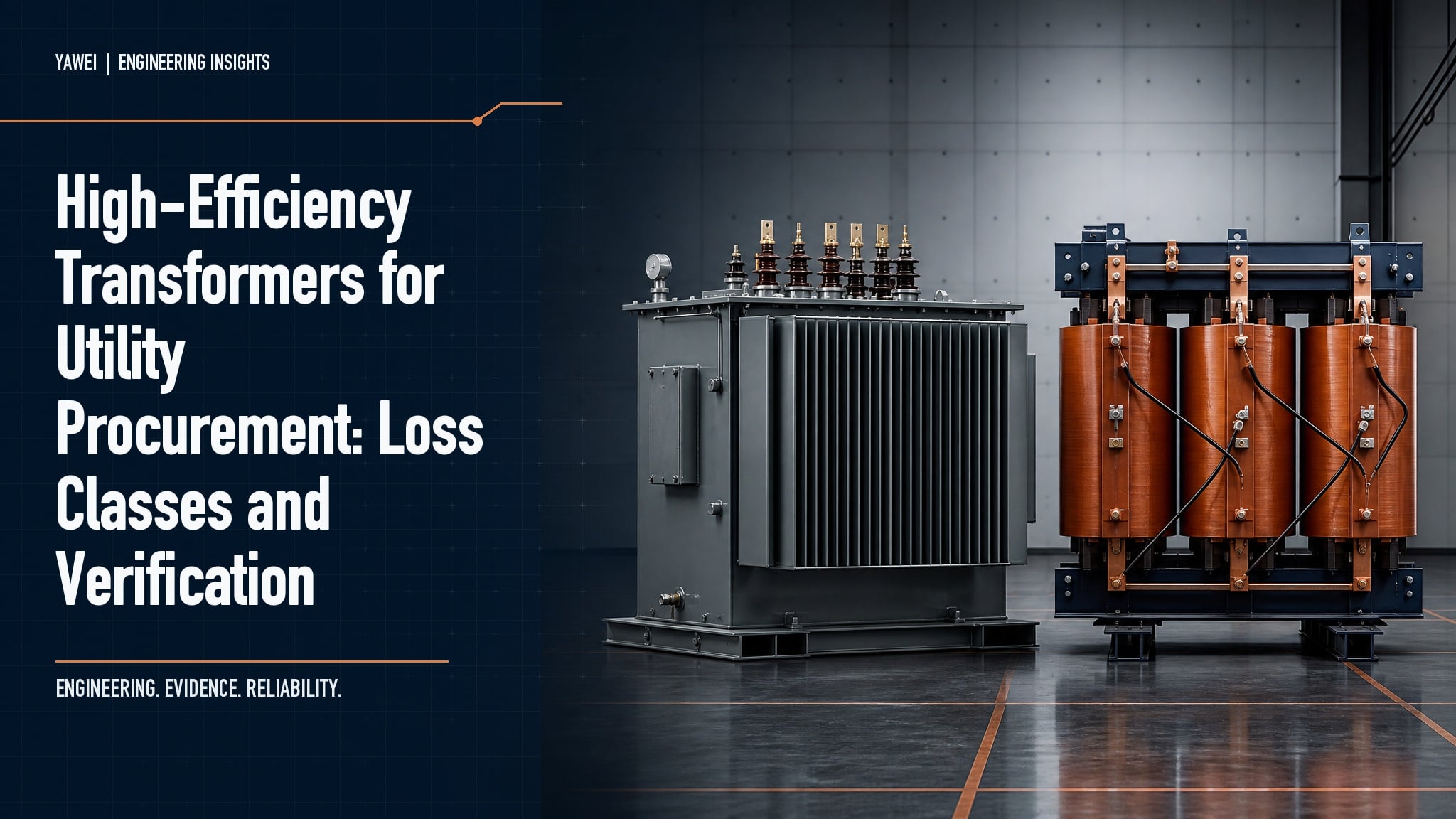
A high-efficiency transformer is not a marketing label. For a utility, it is a unit whose no-load and load losses meet a defined efficiency class or loss level, for a stated capacity and market, and whose performance is evidenced by a test report rather than by a catalogue adjective. This guide walks through how utilities define and procure a high-efficiency transformer: the loss classes and minimum efficiency steps that apply in different markets, the technologies that deliver those losses, the payback logic used to justify the premium, and the verification steps that confirm the numbers are real.
What defines a high-efficiency transformer for procurement
Procuring a high-efficiency transformer relies on two interchangeable descriptions of the same thing. The first is a loss level: the guaranteed no-load loss and load loss, in watts, at a given kVA. The second is an efficiency class: the minimum efficiency that the applicable regulation requires at that kVA. In North America the governing references are US DOE and Canadian CSA. YAWEI publishes the following official efficiency references for its distribution range:
Two conclusions follow. First, "high efficiency" is always capacity- and product-specific: the same percentage does not describe a 15 kVA pole unit and a 2,500 kVA pad unit. Second, a high-efficiency transformer is normally compared on no-load loss and total loss rather than on a single efficiency figure, because two units can share an efficiency class while carrying very different iron loss. Third — and this is often overlooked in bids — each of these references is bounded by market and product type: the DOE and CSA values above apply to distribution transformers sold into the United States and Canada respectively, and the EU framework described next applies to units placed on the European market.
Loss classes across the main markets
The three major efficiency frameworks a utility buyer will meet do not use the same vocabulary.
- United States: US DOE sets minimum efficiency by capacity and transformer type, with the 2013 and 2016 updates covering, among others, three-phase pad-mounted and single-phase pole-mounted distribution units. Compliance is demonstrated by efficiency data meeting the DOE minimum and by supporting test evidence; US market access usually also calls for UL 1561/1562 safety certification and IEEE C57 compliance.
- Canada: CSA standardises efficiency through standards such as CSA C802.1 (energy efficiency) and CSA C227.3 for single-phase pad-mounted units, and CSA 2023 efficiency values are quoted alongside the DOE figures above.
- European Union: the ErP/Ecodesign framework (Lot 2 for transformers) sets loss classes such as Tier 1 and Tier 2. YAWEI's cast-resin dry-type range is published as reaching the Ecodesign Tier 2 loss class. European procurement generally also expects CE/EU-standard conformity and environmental-compliance documentation alongside the efficiency tier.
A buyer who asks for a high-efficiency transformer without naming the market is asking an unanswerable question. The efficiency step should always be written against a named regulation — US DOE, Canadian CSA, EU ErP/Ecodesign, or the China energy-efficiency grade — and against a named product type.
Amorphous cores and the no-load loss lever
The most direct way to lift energy performance is to attack iron loss. YAWEI produces amorphous-alloy transformers, and the technology is listed among its distribution product types. Replacing an ordinary silicon-steel core with an amorphous-alloy core mainly reduces no-load loss, which is typically 60%–80% lower than a conventional silicon-steel design, and thereby cuts the transformer's annual no-load energy consumption. The actual saving is not a fixed number: it depends on the unit's annual operating hours and load factor, and the estimate should be built as the no-load loss difference multiplied by annual operating hours and then converted at the electricity price. For a utility, that is exactly the level of rigour expected when a high-efficiency transformer is proposed as an upgrade rather than a like-for-like replacement, because the benefit scales with running time and not with nameplate size.
Natural ester and biodegradable insulating fluids
Efficiency and environmental performance increasingly travel together. YAWEI's materials note that high-flash-point synthetic oils — silicone oil and ester oil — and natural ester oils such as BIOTEMP are favoured for their safety and environmental friendliness, especially indoors and in environmentally sensitive locations. Natural ester is biodegradable, non-toxic and fire-resistant, falling into the K-class of less flammable fluids, and pole-mounted transformers can be supplied with biodegradable insulating fluid for environmentally sensitive areas. These fluids do not change the loss class, but they change where a high-efficiency transformer can be placed and how much fire-engineering work surrounds it, which matters whenever a unit is sited near buildings or sensitive ground.
Technologies that support carbon-reduction and efficiency rules
Beyond cores and fluids, several design choices help a utility satisfy carbon-reduction and energy-efficiency obligations. YAWEI highlights dry-type transformers as environmentally friendly, oil-free, self-extinguishing and low in fire risk; cast-resin dry-type units reaching Ecodesign Tier 2; and three-phase pad-mounted units that the company states exceed the Energy Star and DOE efficiency standards. The broader technology set that supports regulatory targets includes amorphous-alloy cores that sharply cut no-load loss, high-permeability silicon steel and low-loss design, high-efficiency cooling and temperature-rise control, and dry-type or otherwise oil-free insulation with low fire risk. In selection, the efficiency step should be matched to the target-market rule — EU ErP, US DOE, Canadian CSA or the China energy-efficiency grade — rather than assumed to be identical everywhere.
Payback and capitalized loss evaluation
A premium is only justified by a payback calculation, and the payback of a high-efficiency transformer depends on four variables: the initial price difference, the loss difference, the electricity price and the annual operating hours. Reflecting that dependency, the payback period typically ranges from several years to over a decade — the larger the loss difference, the higher the electricity price and the longer the running time, the faster the return. The recommended method is to compute the total cost of ownership by capitalized loss evaluation, converting the annual loss energy into a present value using the electricity price and the operating hours, and then to base the purchase decision on that comparison. Because the inputs are project-specific, no supplier can credibly promise one universal payback figure; what can be offered is measured loss data from which the buyer's own model produces the answer.
Verifying no-load and load-loss test results
Verification is where a high-efficiency transformer claim either stands or falls. YAWEI's catalogue lists no-load and load losses by capacity, and the company states that products pass routine, type and special tests at the National Transformer Quality Supervision and Inspection Center, the China Electric Power Research Institute (Wuhan) and the Suzhou Electrical Apparatus Research Institute, with 10 kV/35 kV products holding third-party certification (IEC, UL, TUV, CE, KEMA, GOST). To verify a loss claim the buyer should require: a type-test report issued by a qualified laboratory, including the measured no-load and load-loss values; the applicable test standard and the loss tolerance, such as the IEC 60076-1 loss tolerance; and evidence that the report's covered capacity and voltage class match the unit being purchased. Where the loss guarantee is critical, the buyer may request witnessing of routine tests, or obtain the original test records together with the calibration certificates for cross-checking. Independent third-party reports, for example from KEMA or CESI, provide further corroboration of a high-efficiency transformer's guaranteed losses.
Connecting solar and wind farms to the grid
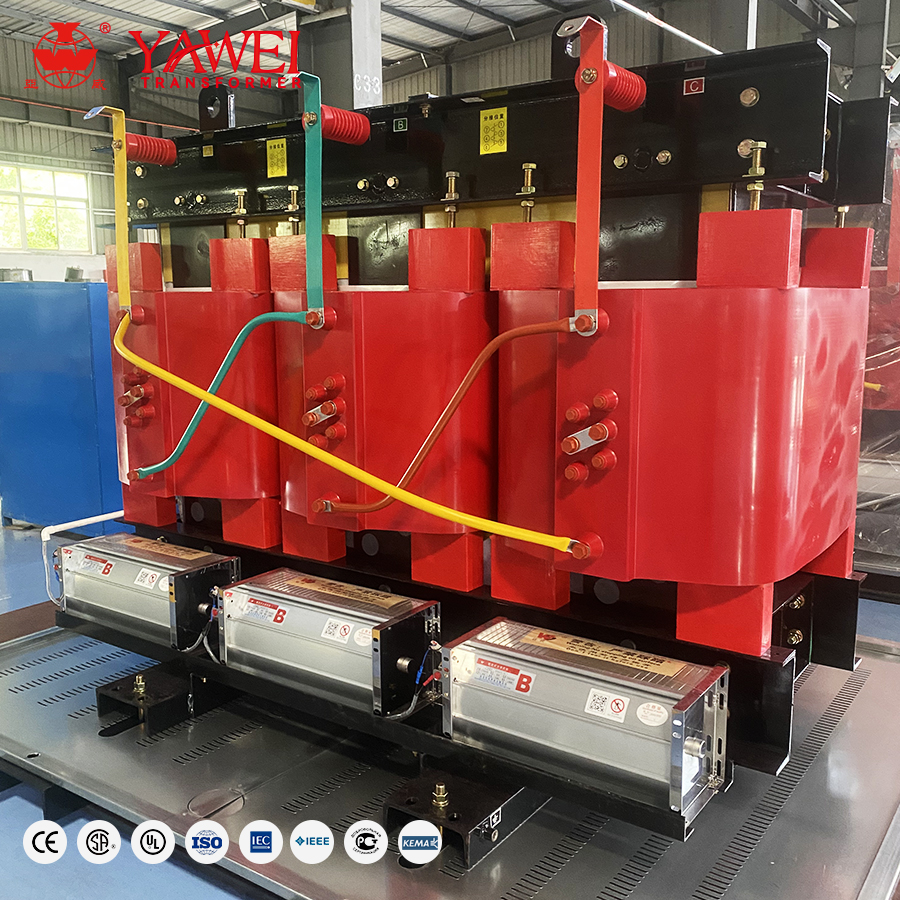
Efficiency questions also arise when generation is added. For connecting solar or wind farms to the transmission grid, YAWEI states that it supplies generator step-up transformers for renewable generation within its power-transformer line, lists a photovoltaic/wind power transformer among its products, applies pad-mounted transformer tanks to solar and wind farms, and lists wind-mill farms and renewable energy among compact-substation applications. These are the transformer types the company offers for renewable grid connection, and the same efficiency and loss-class logic described above governs their specification.
Building a loss-class comparison table
In a competitive tender, the fastest way to compare options is to reduce every bid to one table with fixed columns: product type, rated capacity, no-load loss, load loss at the reference temperature, the loss tolerance, and the efficiency class claimed for the named market. A high-efficiency transformer bid should populate those columns with measured values and a report reference, not with a rounded percentage. The table also exposes the traps that make cross-market comparison unsafe — a unit quoted against a 2016 reference cannot be ranked directly against one quoted against a 2023 reference, and a pad-mounted unit cannot be ranked against a pole unit on the same percentage. Once the columns are aligned, the buyer applies a single capitalized-loss model to every row, and the comparison becomes arithmetic rather than argument.
Specifying a high-efficiency transformer in the RFQ
The requirement should be written as a guarantee, so that it survives into the contract. To specify a high-efficiency transformer properly, the RFQ should state the market regulation and its version, the product type and capacity, the guaranteed no-load loss and load loss with the applicable tolerance, and the test standard under which they must be demonstrated. It should require the type-test report as a deliverable, name the acceptance market, and state whether routine-test witnessing is available. Set out this way, the high-efficiency transformer requirement gives the buyer a single, verifiable column to compare across suppliers, and it gives the supplier a clearly bounded target rather than an ambiguous aspiration. Where the utility applies its own loss-evaluation coefficients, the same data lets the buyer rescore the high-efficiency transformer against the utility's real electricity price and utilization hours.
Application example
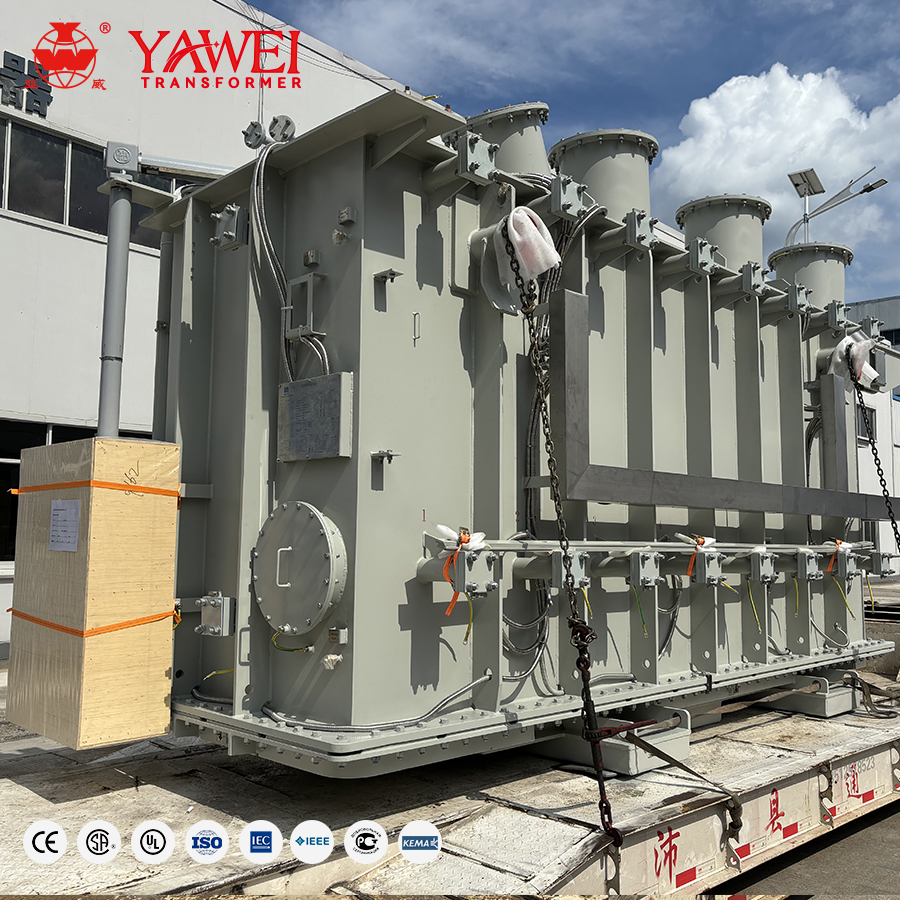
An official project reference that illustrates the procurement context is YAWEI's 15 MVA pad-mounted transformer project for a United States transmission company. The published reference describes a 15 MVA pad-mounted unit and notes the North American market requirements including UL and IEEE. The official source does not disclose a project date, so no date is asserted here. The case is useful precisely because it shows why an efficiency and loss claim must be tied to a named market framework: a high-efficiency transformer destined for a US transmission customer has to satisfy the UL and IEEE documentation expected in that market, not a generic efficiency statement.
For the final engineering review, treat high-efficiency transformer as a project-specific decision term rather than a substitute for the approved datasheet.
Quality Assurance & Standards Notes
The following notes summarize the assurance evidence a buyer should attach to any high-efficiency transformer specification.
- System and product qualifications: YAWEI states ISO 9001, ISO 14001, ISO 45001 and SA8000 system certification plus a Jiangsu enterprise metrology qualification, and states that its 10 kV/35 kV distribution transformers and substations hold IEC, UL, TUV, CE, KEMA and GOST certification; the company states its products comply with IEC, IEEE, ANSI, CSA and EN.
- Test basis: routine, type and special tests are stated to be performed at the National Transformer Quality Supervision and Inspection Center, CEPRI (Wuhan) and the Suzhou Electrical Apparatus Research Institute.
- Market scope: the DOE 2013/2016 and CSA 2023 values quoted above are distribution-transformer efficiency references for the US and Canadian markets; Ecodesign Tier 2 governs the EU market; and UL 1561/1562 plus IEEE C57 are cited for US projects, while CSA/ULC are cited for Canadian projects. Each reference should be confirmed against the exact target regulation before being written into a specification.
- Verification: require the type-test report, the loss tolerance, and the covered capacity/voltage class, and treat an independent third-party report as the strongest evidence of a guaranteed high-efficiency transformer loss.
Internal references: Review the three-phase pad-mounted transformer data and the cast-resin dry-type transformer loss class before specifying an efficiency tier.
Table of Contents
- What defines a high-efficiency transformer for procurement
- Loss classes across the main markets
- Amorphous cores and the no-load loss lever
- Natural ester and biodegradable insulating fluids
- Technologies that support carbon-reduction and efficiency rules
- Payback and capitalized loss evaluation
- Verifying no-load and load-loss test results
- Connecting solar and wind farms to the grid
- Building a loss-class comparison table
- Specifying a high-efficiency transformer in the RFQ
- Application example
- Quality Assurance & Standards Notes