
 EN
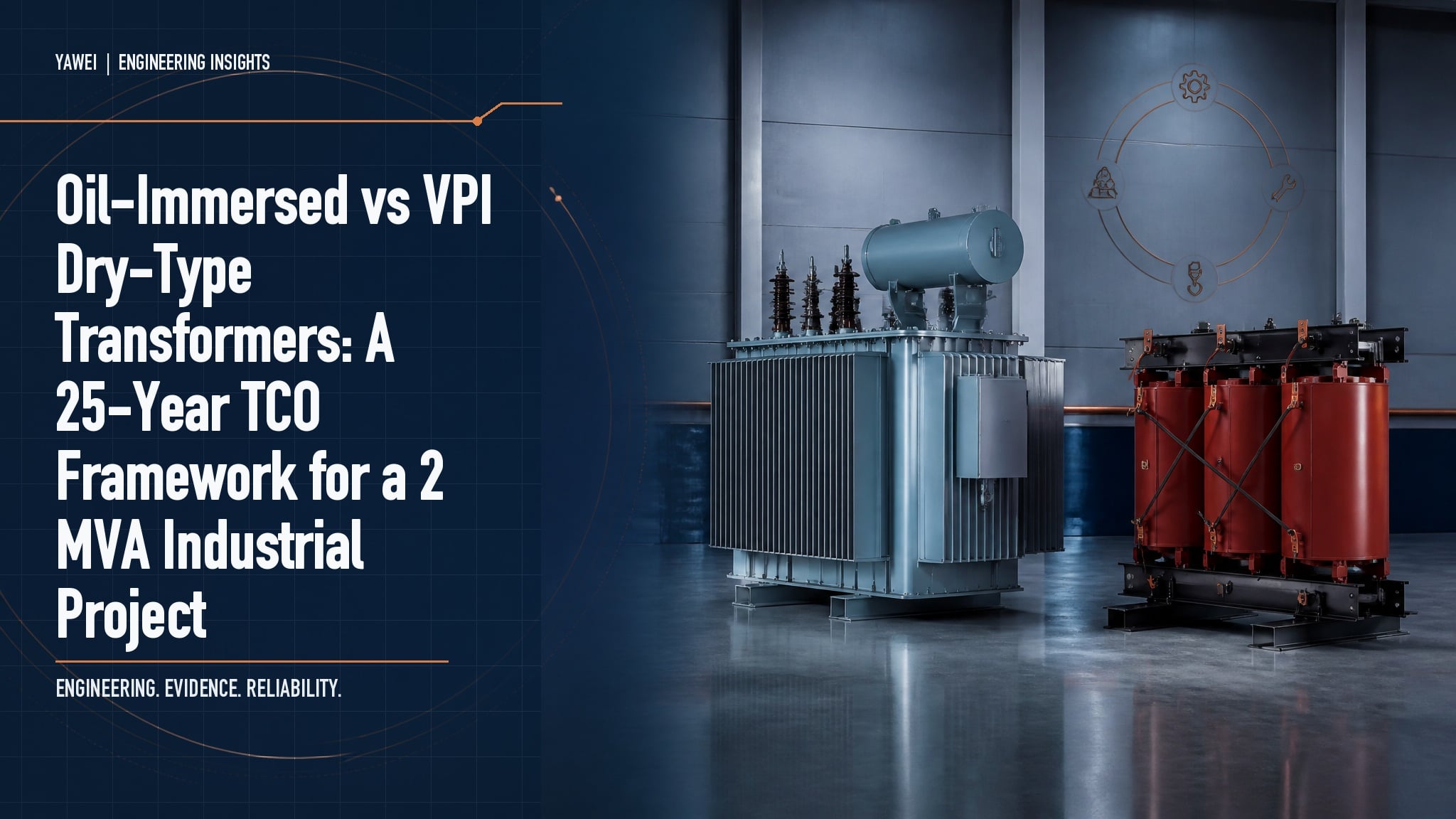
Choosing between an oil-immersed and a VPI dry-type transformer for a 2 MVA industrial installation is rarely decided by purchase price alone, and it should not be. Over a 25-year service life a transformer spends far more on energy and upkeep than it costs to buy, so the decision belongs to a structured total-cost-of-ownership comparison. This article sets out a method — not a foregone conclusion — for building that comparison, drawing only on published product data and standard practice, and it flags in advance where a transformer TCO result is genuinely project-specific rather than universal.
What a transformer TCO framework must capture
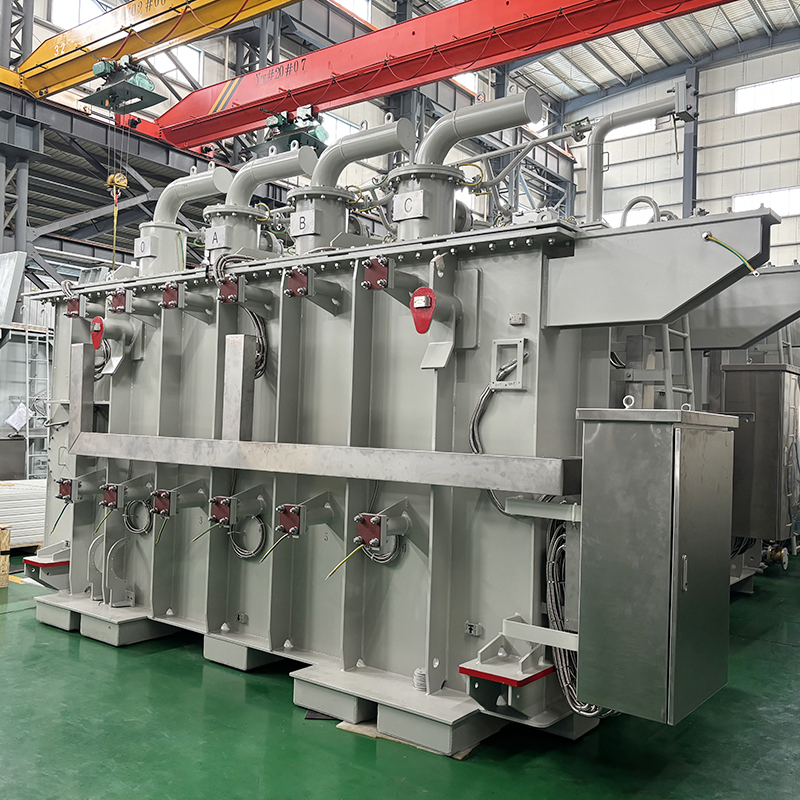
A defensible transformer TCO framework for a 2 MVA unit has five layers, and each must be filled from project data rather than from rules of thumb.
- Initial purchase cost, including accessories and any type-test evidence required by the specification.
- Installation and works cost, including foundations, oil-containment or fire-separation measures where the code requires them, and the electrical connection work.
- Lifetime energy cost, computed from no-load and load losses, the project electricity price and the annual operating hours.
- Maintenance and inspection cost over 25 years, which differs sharply between the two technologies.
- End-of-life disposal and environmental-compliance cost.
The reason the framework matters is that the two technologies trade one layer against another: the option that is cheaper to buy is not necessarily cheaper to own, and the option that is cheaper to run is not necessarily cheaper to install. Building a transformer TCO model means filling all five layers before drawing a conclusion.
Same-rating losses: what the data actually shows
The starting assumption many buyers bring to a transformer TCO study is that a dry-type unit always loses more energy than an oil-immersed unit at the same kVA. The published data does not support such a blanket claim. YAWEI publishes losses per individual product rather than a single same-kVA comparison of oil-immersed against VPI dry-type units. For reference, the 35 kV S11-series oil-immersed table lists, for example, 630 kVA with a no-load loss of 830 W and a load loss of 7,870 W, while the 35 kV dry-type table covers 800–25,000 kVA with no-load losses of 2.02–24.3 kW and load losses of 8.87–101 kW across class B/F/H insulation. At the same kVA rating, the comparison of no-load and load losses has to be based on the specific product data. In general terms, oil-immersed transformers — especially those built with high-permeability silicon steel or amorphous cores — can achieve lower no-load losses, while load losses depend on winding material, since copper windings have lower losses. Because of differences in insulation and heat dissipation, VPI and dry-type loss levels at the same rating may be higher or lower than oil-immersed units. The correct method is to compare item by item using the manufacturer's type-test measured data against the IEC 60076 loss tolerances, rather than inferring from transformer type.
Capitalized losses: the largest transformer TCO lever
Energy is usually where transformer TCO diverges most, and it is dominated by how the unit is loaded. No-load loss (iron loss) is constant whenever the transformer is energised, while load loss (copper loss) varies approximately with the square of the load factor. If the annual load factor is low, no-load loss dominates, so a model with lower no-load loss — for example a high-permeability or amorphous core, or a low-no-load-loss dry-type design — saves more energy under partial-load conditions. If the load stays high for long periods, load loss becomes more heavily weighted and the ranking can change. This is the single most important reason a transformer TCO conclusion cannot be borrowed from another site: the same two units can rank differently under a 20% load factor and under an 80% load factor. The recommended approach is to calculate the cumulative energy consumption of the oil-immersed and dry-type options across the whole life cycle using the project's typical load profile, then convert that consumption to cost at the project electricity price.
Maintenance, oil testing and the transformer TCO of oil-immersed units
Operating routines create a recurring cost line that must be modelled explicitly. YAWEI's FAQ recommends annual inspection of oil pumps, fans and bushings and an annual examination of oil condition for oil-immersed and pad-mounted units, and states that dry-type transformers generally require less maintenance. In practice, an oil-immersed transformer usually needs annual oil sampling — checking oil quality, withstand voltage, moisture and acidity — together with cooling-system checks, with oil filtering or oil changes carried out as needed. A VPI or dry-type transformer has no insulating oil, so it needs no oil sampling and no filtering; its maintenance focuses on cleaning, ventilation and connection checks, with markedly lower maintenance effort. The recommended oil-test intervals are those given in IEC 60422, the mineral-oil maintenance guide, and the manufacturer's manual, while dry-type intervals follow the manufacturer's recommendations. On service life, YAWEI's FAQ gives oil-immersed transformers roughly 20–30 years, extendable to 50–60 years with excellent maintenance, a Canadian market expectation of 25–35 years, and a dry-type life that can reach over 25 years. Because oil-immersed units carry more recurring work, TCO studies that ignore annual oil testing systematically understate the oil-immersed option's lifetime cost.
Fire safety, insurance and code-driven costs inside transformer TCO
Fire and code requirements change not only safety but also the capital and insurance layers of transformer TCO. YAWEI's FAQ states that dry-type transformers reduce fire risk, need no oil-containment system, suit indoor installation and use self-extinguishing insulation, and the cast-resin page describes cast-resin units as self-extinguishing with low fire hazard, suitable for indoor and high-fire-risk areas. Occupancies where dry-type is typically mandated instead of oil-immersed include high-rise buildings, hospitals, schools, shopping malls, underground substations, subways and tunnels, and data centres — places with strict fire-safety, fire-compartment and confined-space requirements that are unsuitable for oil pits or fire-and-explosion-proof rooms, subject to local codes such as GB 50053, the NEC and European building codes. Where an oil-immersed transformer is installed near a building, the local fire code requirements for oil containment, oil-retaining pits, fire-separation distance and ventilation apply. It is worth noting that published clearance figures are available only for single-phase pad-mounted units — at least 10 ft from combustible structures, reducible to 3 ft for non-combustible structures, with working clearances of 8 ft on the left, 10 ft at the front and 3 ft at the rear and right — so for other types the specific values must come from the project-location building and electrical codes. From an insurance standpoint, dry-type units usually obtain better premium terms because fire risk is lower, but the initial purchase cost is higher, whereas oil-immersed units cost less but require additional fire-safety and insurance investment. A transformer TCO model should therefore carry the fire-engineering and insurance consequences of each option as explicit lines, using the insurer's project-specific assessment rather than a generic assumption.
Where each type wins on capacity, site and climate
Technology choice also narrows the realistic options before any TCO arithmetic begins. YAWEI states that oil-immersed transformers are lower in price — typically up to half the price of a same-capacity dry-type unit — and that dry-type transformers operate below 35 kV, so oil-immersed units are usually more cost-effective at larger capacity, at higher voltage or where outdoor long-term operation is required; industry experience places oil-immersed purchase cost about 30%–50% below a same-capacity dry-type, with better heat dissipation at large capacity. Dry-type units are mostly used at medium and low voltage, indoors, or where fire-safety and environmental requirements are high. Site conditions reinforce the split: dry-type units suit a well-ventilated room and confined spaces, but in high-humidity, corrosive or salt-spray environments they need good sealing, coating and ventilation, and may need a higher protection class, whereas open-air, large-capacity, high-temperature or dusty environments usually favour oil-immersed units. In high-temperature regions the preference is explicit — for Middle East EPC transmission projects, oil-immersed transformers are widely adopted because they tolerate high temperature, sand and dust, outdoor and large-capacity duty with no voltage ceiling, typically as ONAN or ONAF units with anti-corrosion coating and sand-dust protection, with dry-type units mostly reserved for below 35 kV, indoors or high-fire-safety duty; IEC 60076 is recommended as the acceptance basis, supplemented by the project country's local grid code. Where indoor or environmentally sensitive placement is unavoidable, high-flash-point K-class oils or natural ester fluids such as BIOTEMP can be selected for their greater safety and environmental profile.
End-of-life disposal and transformer TCO
The final layer is often omitted, yet it belongs in the TCO model. YAWEI's materials give only qualitative guidance here: the FAQ states that disposal must follow local regulations and typically involves draining and reclaiming the oil, dismantling and sending the equipment to recycling centres; the 35 kV page notes that oil-immersed units are easier to recycle than dry-type units; and cast-resin units are described as having lower environmental impact with zero oil use. In practice an oil-immersed transformer at end of life requires oil draining, recovery and treatment of the insulating oil, and disposal of the tank and materials under environmental rules, and it offers a higher recyclable ratio. A dry-type transformer has no oil, so disposal is comparatively simple and environmental-compliance cost is usually lower, though cast-resin or epoxy contains resin that must still be disposed of under environmental requirements. Both options must comply with local disposal and environmental regulations, and the specific costs vary with the recycling market and the applicable regulations, so they are best carried as a line in the life-cycle assessment rather than assumed equal.
Building the 2 MVA transformer TCO model
With the layers defined, the 2 MVA transformer TCO model for a 25-year industrial installation can be assembled. YAWEI's published economics are qualitative rather than absolute: the FAQ states that dry-type may have a higher upfront cost but a competitive or lower total cost of ownership once installation, maintenance and safety are counted, while the 35 kV page states that oil-immersed units at the same capacity are often half the price of dry-type and cast-resin is described as needing practically no maintenance. For a 2 MVA industrial installation over 25 years, the total cost of ownership must combine initial purchase, annual loss cost at the project electricity price and annual hours, maintenance cost, installation and fire-protection works, and end-of-life disposal cost. Oil-immersed is low upfront but higher in operation and maintenance; dry-type is high upfront but low in operation and maintenance; the final result depends on electricity price, load factor and maintenance strategy. Because those three inputs are project-specific, a transformer TCO result is an output of the buyer's own model, not an input that can be imported from a brochure. The recommended method is therefore to perform a capitalized TCO calculation using the project's electricity price and load profile, and to document the transformer TCO assumptions — evaluation period, electricity price, annual hours, load profile, maintenance interval and discount rate — so the comparison can be audited and reproduced.
Application example
An official project reference that shows an industrial, high-demand application is YAWEI's 132 kV power transformer used in the substation of a steel factory in Seville, Spain. The published reference describes a power transformer installed for a steelworks substation and notes a large electric-arc-furnace load profile, an industrial duty with strong cyclic and harmonic loading that calls for high short-circuit withstand and appropriate impedance and overloading margins. The official source does not disclose a project date, so no date is asserted here. For a 2 MVA industrial transformer TCO exercise the lesson is that the load profile, not the technology label, drives the energy and reliability layers of the model.
Quality Assurance & Standards Notes
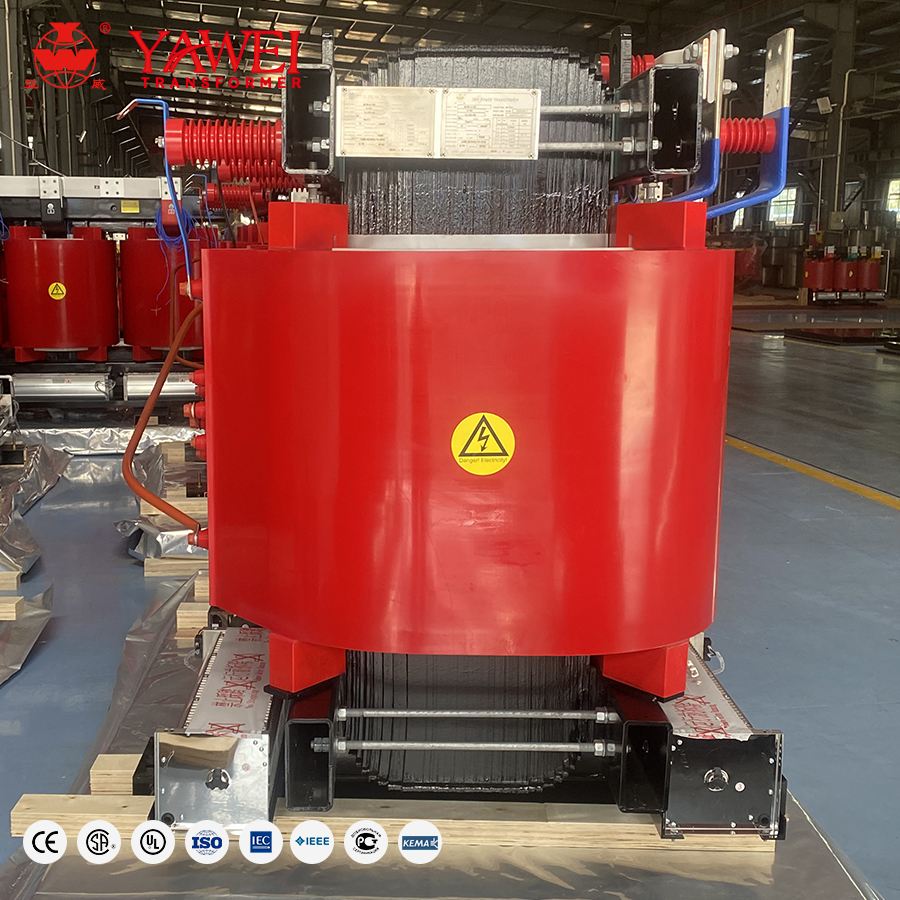
- System and product qualifications: YAWEI states ISO 9001, ISO 14001, ISO 45001 and SA8000 system certification plus a Jiangsu enterprise metrology qualification, and states that its 10 kV/35 kV distribution transformers and substations hold IEC, UL, TUV, CE, KEMA and GOST certification.
- Standards scope: oil-immersed transformers are stated to follow IEC 60076; the IEC 60076 loss tolerances apply to loss comparison, IEC 60422 governs mineral-oil maintenance practice, and local fire and building codes (for example the NEC, GB 50053 and European building codes) govern clearances and containment. These references describe different scopes and must not be applied interchangeably.
- Method note: every cost statement above is qualitative and source-derived. No single absolute transformer TCO figure, payback period or insurance cost is asserted, because all depend on project electricity price, load factor, code requirements and the insurer's own assessment.
- Verification: request type-test reports with measured no-load and load losses, the applicable tolerance, and the covered capacity and voltage class, so the loss layer of the model rests on tested data.
Internal references: Compare the published oil-immersed transformer data with the cast-resin dry-type transformer figures before finalizing a transformer TCO model.
Table of Contents
- What a transformer TCO framework must capture
- Same-rating losses: what the data actually shows
- Capitalized losses: the largest transformer TCO lever
- Maintenance, oil testing and the transformer TCO of oil-immersed units
- Fire safety, insurance and code-driven costs inside transformer TCO
- Where each type wins on capacity, site and climate
- End-of-life disposal and transformer TCO
- Building the 2 MVA transformer TCO model
- Application example
- Quality Assurance & Standards Notes