
 EN
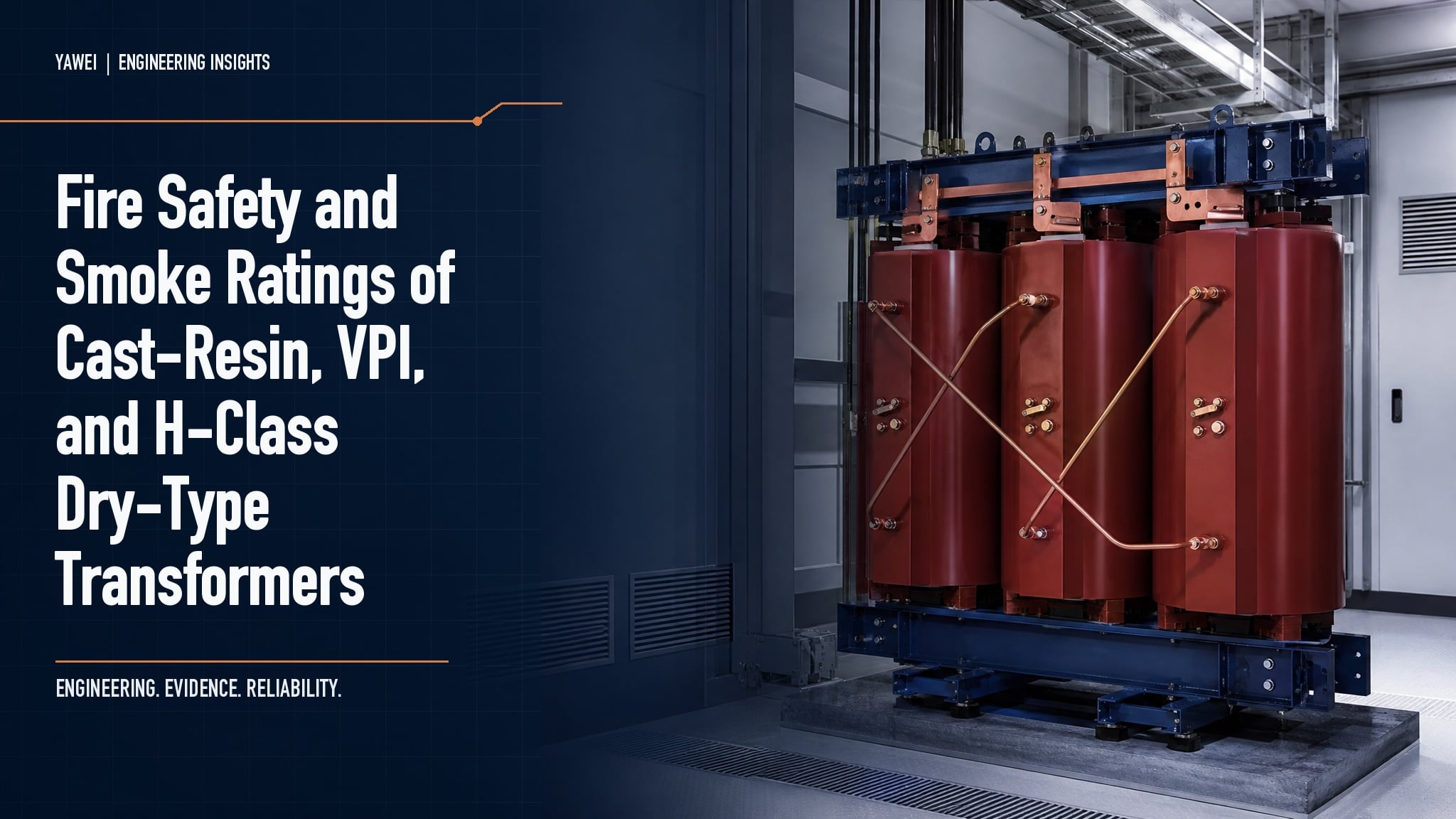
When a transformer is installed inside a building, a tunnel, a data hall, or a densely occupied commercial site, the specification conversation changes. Performance and price still matter, but dry-type transformer fire safety moves to the top of the agenda, because the equipment sits close to people, assets, and evacuation routes. Dry-type transformers eliminate the flammable insulating oil that drives the fire and explosion risk of liquid-filled units, but "dry-type" is a family, not a single technology, and cast-resin, vacuum-pressure-impregnated (VPI), and H-class designs differ in how they are built, how they behave under thermal stress, and — importantly — how much of that behavior is publicly documented. This article explains what the available evidence does and does not say about dry-type transformer fire safety, and how specifiers should close the gaps with project-specific test data.
Why Dry-Type Design Changes the Fire Question
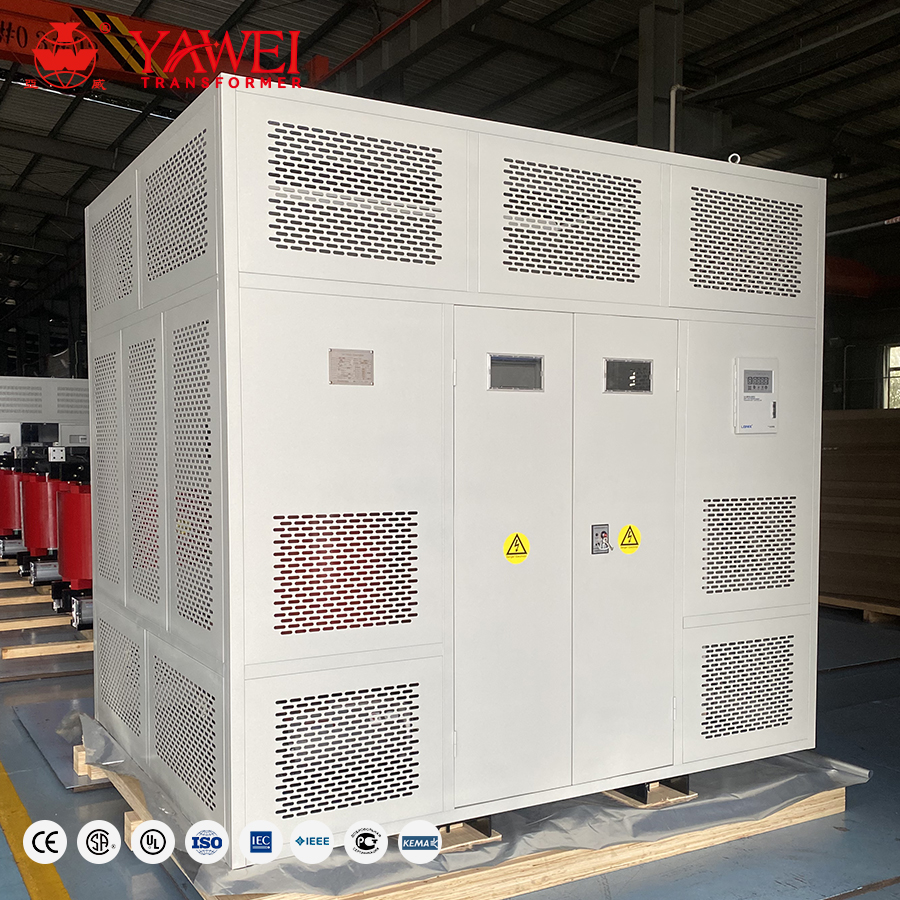
A dry-type transformer has no liquid insulating medium. Its magnetic circuit and windings are cooled by air, and its insulation is applied as a solid system rather than as oil. That single fact removes the fuel source that makes oil-immersed transformers a fire and environmental concern, and it is the foundation of dry-type transformer fire safety. Official material describes dry-type units as using self-extinguishing insulation and as safer because they contain no flammable oil, and notes that dry-type units do not require the fire-resistant vaults or catch basins associated with liquid-filled transformers and do not release the same harmful gases. For buildings and indoor rooms, those characteristics can simplify civil design and reduce protection requirements — provided the specification confirms them for the exact product being purchased.
It is worth being precise about what dry-type transformer fire safety does not mean. A dry-type unit is not fireproof, and the absence of oil does not remove every possible combustion source; insulation materials can still be affected by a sustained external fire or by severe overheating. What the dry-type design does is remove the large volume of flammable liquid and the associated risk of an oil-fed fire or tank rupture, substituting a solid insulation system whose behavior can be evaluated through material and product testing. Dry-type transformer fire safety is therefore best understood as a risk-reduction strategy that must still be matched to the installation's fire protection concept, its occupancy, and its evacuation design rather than treated as an unconditional guarantee.
Cast-Resin: Fully Enclosed Epoxy
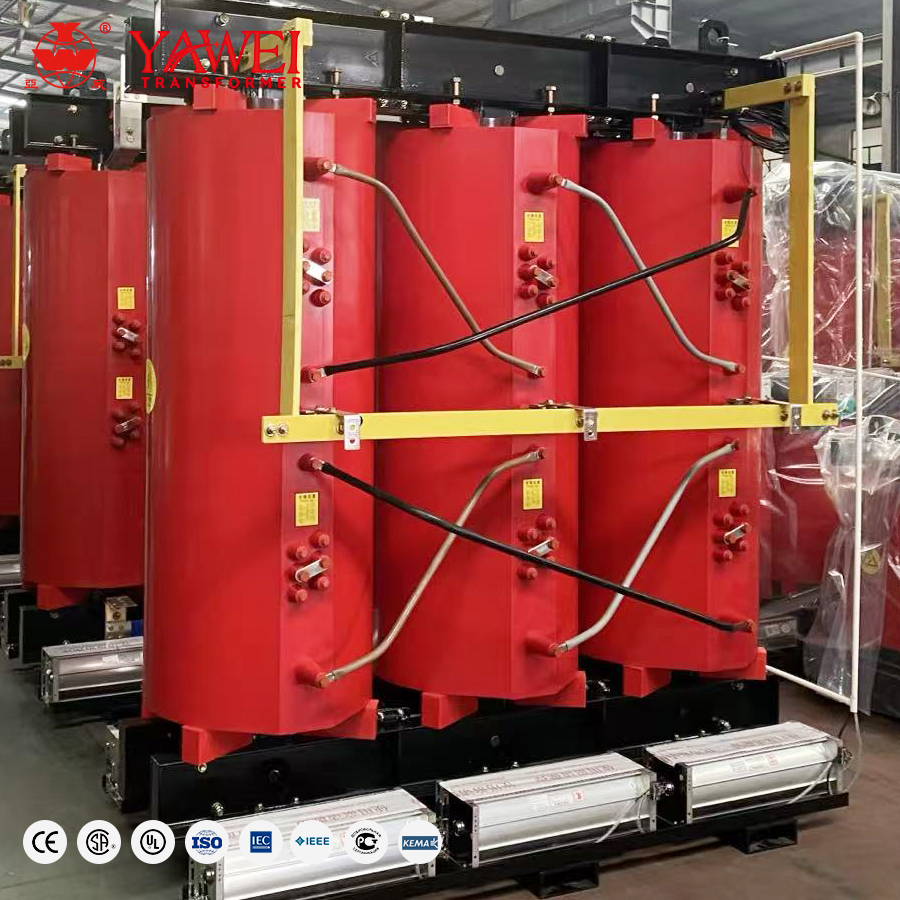
The cast-resin dry-type transformer is the reference point for much of the industry's dry-type transformer fire safety thinking. In this design, the windings are encapsulated in an epoxy-resin mixture, forming a solid, fully enclosed insulation system. The official cast-resin product page describes cast-resin units as self-extinguishing with low fire hazard, and as suitable for commercial, industrial, and residential sites, including indoor applications and areas with high fire risk. Because the insulation is a sealed solid, cast resin also offers good protection against moisture and dust, which is why it is often recommended for humid or dusty environments. From a dry-type transformer fire safety perspective, the epoxy encapsulation is the key feature: a solid, self-extinguishing insulation system limits the material available to sustain combustion and protects the winding from environmental contamination that could otherwise degrade insulation performance over time.
VPI: Vacuum-Impregnated Epoxy
VPI dry-type transformers are also built on an epoxy-resin insulation concept, but the process differs: the winding is vacuum-impregnated with epoxy resin rather than cast inside a sealed resin block. Official FAQ material states that VPI is vacuum-impregnated with epoxy resin while cast resin is cast with epoxy resin, and that VPI units are generally more compact, whereas cast resin offers better protection against environmental factors. Client-supplied guidance adds that VPI units are somewhat less protected against harsh environments than cast resin but remain dry-type, oil-free designs. For dry-type transformer fire safety, VPI shares the fundamental advantage of the dry-type family — no flammable liquid and a resin-based insulation system — while its more compact construction may suit space-constrained rooms. The trade-off is that environmental protection is generally described as lower than cast resin, so moisture, dust, and pollution levels at the installation should be checked against the product's stated environmental capability.
H-Class: High-Temperature Insulation, Limited Public Data
H-class dry-type transformers use insulation systems rated for higher operating temperatures — commonly associated with a 145 °C temperature-rise class and higher permissible insulation temperatures. H-class designs are attractive where high ambient temperatures or demanding duty cycles are expected, and official dry-type material references H-class insulation as part of the product range. However, one important limitation applies to dry-type transformer fire safety: the official site does not disclose specific fire-performance or smoke data for H-class units, and detailed data for cast-resin, VPI, and H-class designs is not published for direct comparison. That absence is not evidence of a problem; it simply means the buyer must obtain the data rather than assume it. Requesting that data early, directly from the manufacturer and for the exact product offered, is the single most practical step a buyer can take to place dry-type transformer fire safety on a firm footing.
What About Smoke Emission Ratings?
Smoke emission is the point where dry-type transformer fire safety is most often over-claimed. Buyers reasonably want to know how much smoke a transformer produces if its insulation is exposed to fire, and whether that smoke is toxic. The honest position is that the available official material does not publish specific smoke-emission, combustion, or smoke-toxicity ratings for cast-resin, VPI, and H-class dry-type transformers. Smoke emission depends on the insulation material and its formulation, which vary by manufacturer and product, so a generic figure would be misleading. The correct approach for dry-type transformer fire safety is to require evidence: buyers should ask the manufacturer for the combustion and smoke-toxicity test information applicable to the specific product, including the material fire-performance data used for the insulation system. Where a project's fire strategy, insurer, or authority requires defined smoke or toxicity classifications, the specification must name the required test standard and the acceptance level, and the supplier must confirm compliance with test documentation for the exact product offered. Dry-type construction reduces fire and explosion risk relative to oil-immersed units, but it does not by itself establish a smoke rating.
Where a project's fire strategy, insurer, or authority requires a defined smoke or toxicity classification, the buyer should treat that classification as a specific technical requirement rather than an assumed property of dry-type construction. Practical steps include naming the applicable test standard in the specification, requesting the manufacturer's material test data for the insulation system, and confirming that the offered product has been assessed to the required level for the exact configuration. If a supplier cannot provide the supporting documentation, the correct response is to seek an alternative product rather than to accept a verbal assurance. Handled this way, dry-type transformer fire safety becomes an auditable element of the project's fire strategy instead of a hopeful assumption.
Fire Safety Beyond the Transformer
Dry-type transformer fire safety is also a system property, not only a product property. Even with self-extinguishing insulation, installation conditions determine real-world behavior. The official guidance for dry-type units calls for adequate ventilation, appropriate clearances, and protection against moisture, dust, and corrosive atmospheres in demanding environments. Cooling class matters too: cast-resin units may be offered in ANAN or ANAF (fan-assisted) configurations, and ventilation must match the selected cooling. Temperature rise and ambient limits should be respected — official data references temperature-rise classes of B 100 °C, F 120 °C, and H 145 °C — and installations above 1,000 m elevation generally require insulation and cooling correction. Enclosure rating is a further factor: a unit supplied with an IP-rated enclosure behaves differently in a dusty room than an open IP00 unit. Taken together, these installation variables are as important to dry-type transformer fire safety as the choice between cast-resin, VPI, and H-class technology.
An Application Example
The clearest officially documented application for dry-type transformer fire safety is the use of cast-resin units in indoor, commercial, and residential settings and in areas with high fire risk. The official cast-resin page explicitly positions cast-resin transformers for these environments, citing their self-extinguishing, low-fire-hazard characteristics and their suitability where a liquid-filled unit would require additional fire protection. In such locations the specification logic is straightforward: because the transformer is installed close to occupied space, the fire and smoke behavior of the insulation system becomes a design input rather than an afterthought, and the buyer should confirm the product's fire-performance documentation accordingly. This example also shows why dry-type transformer fire safety must be specified by the buyer's risk profile rather than assumed from the broad "dry-type" label.
A Specification Checklist
To specify dry-type transformer fire safety with confidence, address the following points. Confirm the technology — cast-resin, VPI, or H-class — and match it to the temperature and environmental conditions expected at site. Require the insulation system's fire-performance and, where relevant, smoke and toxicity test data for the specific product. State the required test standard and acceptance class if the fire strategy or insurer demands one. Verify ventilation, clearances, enclosure rating, and cooling class for the installation. Confirm temperature-rise class and any altitude correction. Finally, record the after-sales and maintenance expectations, since cleaning, connection checks, and ventilation upkeep preserve insulation condition over the service life. Each of these items converts a general claim about dry-type transformer fire safety into a verifiable project requirement.
You can review the insulation and construction details for cast-resin dry-type transformers and compare the wider dry-type transformer range when building your fire-safety specification.
Quality Assurance & Standards Notes
For dry-type transformer fire safety, the guiding principle is evidence over assumption. Official material states that dry-type transformers use self-extinguishing insulation and are safer because they contain no flammable oil, and describes cast-resin units as self-extinguishing with low fire hazard and as suited to indoor and high-fire-risk locations; VPI units are described as vacuum-impregnated with epoxy resin, and H-class units use higher-temperature insulation, but the official site does not publish specific smoke or combustion ratings for the three technologies. Buyers must therefore request combustion and smoke-toxicity test information for the exact product from the manufacturer, and, where a project's fire strategy or authority requires defined classifications, specify the applicable test standard and acceptance level and verify it with test documentation. Jiangsu Yawei Transformer holds ISO 9001, ISO 14001, and ISO 45001 system certifications together with SA8000 and a Jiangsu enterprise metrology certification, and states that its 10 kV and 35 kV distribution transformers and substations hold IEC, UL, TUV, CE, KEMA, and GOST certifications, with products tested at the National Transformer Quality Supervision & Inspection Center, CEPRI Wuhan, and the Suzhou Electrical Apparatus Research Institute. System certification, product certification, standard compliance, and third-party test reports each document a different layer of assurance and should be checked individually and against the specific product ordered.
Table of Contents
- Why Dry-Type Design Changes the Fire Question
- Cast-Resin: Fully Enclosed Epoxy
- VPI: Vacuum-Impregnated Epoxy
- H-Class: High-Temperature Insulation, Limited Public Data
- What About Smoke Emission Ratings?
- Fire Safety Beyond the Transformer
- An Application Example
- A Specification Checklist
- Quality Assurance & Standards Notes